Let's suppose that you're photographing some basically human things. So, we're setting aside Landscapes, Abstracts, Still Lifes, Macro Photos of Bugs, and so on. This is a lot of stuff, to be sure. But let's suppose you're shooting Street, or Documentary, or something like that.
The essential hurdle photographers run in to here is People. Can you, or Can You Not, photograph people from up close and personal?
People have a sort of bubble around them, I imagine it shaped a bit like this:
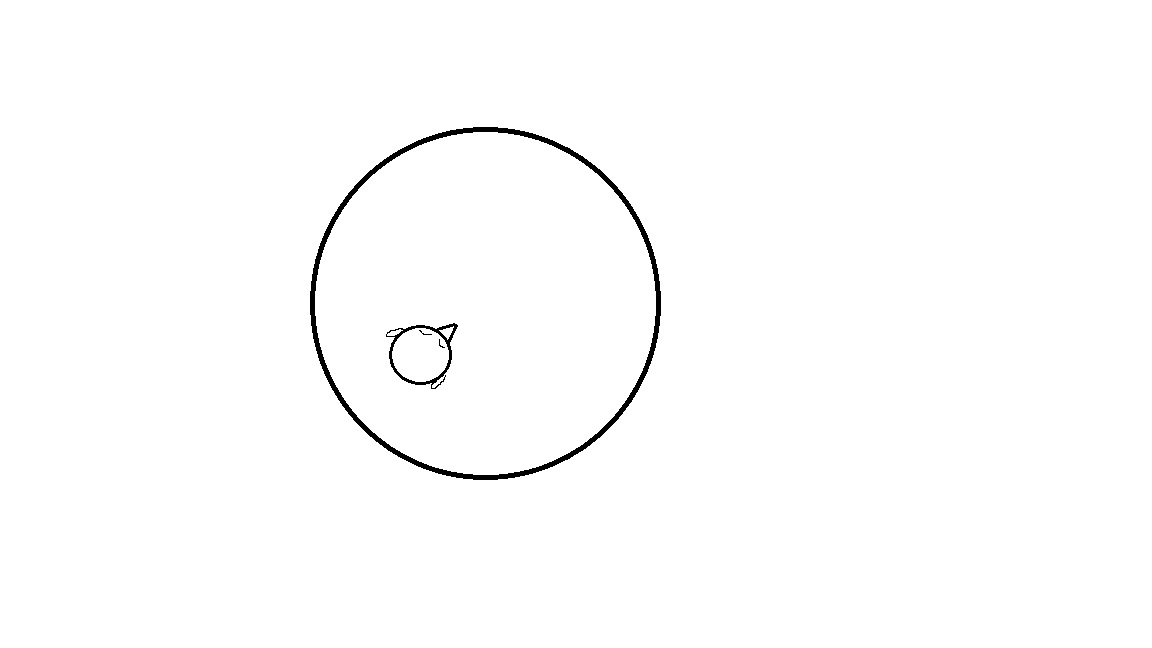
The edges of the bubble are vague, the size and the fuzziness are personal and contextual. The point is that the closer you get to someone, the more likely you are to have to engage them socially. You can get closer from behind than from the front. As you approach, at some point there's a chance of eye contact, of registering your presence. At some point there's an obligation to acknowledge the other person. At some point someone's going to have to say "Hi" or risk a horrid awkward silence.
There is, for everyone, a cost associated with entering the bubble. It's going to take effort and energy. In the first place you either need to interact socially, or consciously thrust down that urge. In the second place, there is risk of rejection, of a negative social interaction. This is true, I think, for everyone. Except, perhaps, for sociopaths of a certain stripe. We're social animals, and this is part of that.
Some people can and do enter those bubbles constantly, other people never, ever, enter the bubble. The latter take a lot of pictures of people from behind, or in the distance. The latter will often have a line of patter about how they want to abstract the humanity of the scene or photograph something Universal rather than specific or whatever. And, sure, that could be a thing. Those are legit pictures too.
I have a hell of a hard time entering The Bubble myself. I'm socially competent, but not very gregarious. I'm an introvert, so these things consume quite a bit of energy.
But here's the rub. If you won't enter The Bubble, your camera isn't in The Bubble either. And that in turn means that people looking at your pictures are not in The Bubble. They're outside. People in the frame are beyond the boundary of social interaction, they are safely distant. They might be far away, they might be turned away, they might simply be distracted.
Be keeping yourself emotionally safe, by taking pictures from that safe emotional distance you make pictures which are -- duh! -- emotionally distant. It's baked in. You can't fake it. We're social animals, we know intimately, powerfully, when we're inside that emotional-engagement zone, and when we are not. A long lens is not going to make up for your timidity.
As a consequence of this the emotional palette of your pictures is limited. You can go all the way from "dystopian hell" to "neutral." If the scenes are of a sort in which we expect social things to occur, and there is nothing social in the pictures, it's going to feel off. If you simply leave people out, you're likely to end up with an "abandoned" vibe, although it's just as likely you simply waited for the moment when nobody was in-frame. If you photograph people from behind, or from a distance, it will feel anonymous, distant. Even a crowd can be photographed as distant, aloof, unsociable.
Suppose you want to photograph human scenes, pictures in which we expect some sort of social engagement. Suppose you want to project a positive mood. Well, you're going to need to get into some bubbles and engage some people. Your camera needs to be engaged, so the viewers of your pictures feel engaged.
Perhaps this is what what's-his-name (was it Capa?) meant when he said something about "If your pictures aren't good enough you're not close enough."
Friday, May 4, 2018
Thursday, May 3, 2018
Haiku
Mike Chisolm reminded me obliquely that Jack Kerouac wrote a lot of haiku, and that these are easily my favorite things in his oeuvre. So I went and got out my edition of these things and whiled away a little happy time.
And then I made a picture.
I call it incisive lens-based criticism of Kerouac's poem but you are welcome to consider it this picture that popped into his head after he read the poem which I think means the same thing.
And then I made a picture.
The sound of silence
is all the instruction
You'll get
is all the instruction
You'll get
I call it incisive lens-based criticism of Kerouac's poem but you are welcome to consider it this picture that popped into his head after he read the poem which I think means the same thing.
Wednesday, May 2, 2018
AmeriKKKa Sucks Porn
I ran across this thing this morning: Susan Lipper, trip: 1993-1999 which has, I suppose, its merits. Blah blah uniquely female perspective feminist etc etc. What it shares with a lot of other work we've seen is this vision of an America that is terrible. It is probably an "incisive critique of Trump's America" or some goddamned thing. We see way too much of this shit, because coastal elites and Euros love it.
Even middle Americans produce this garbage for the slavering effete. I'm looking at you, Alec Soth.
So I said to myself, "Self, this stuff is not only shit, it's lazy. Let's prove it."
This morning I went down to Railroad Avenue in my small city of Bellingham. I spent about 50 minutes shooting, about 1 frame a minute. The goal was to produce two completely different views of the Bellingham. I am intimately familiar with the visual landscape of this street, so I knew it would easily generate the breadth I needed, so in that sense I cheated. But really, I spent less than an hour, shot less than 50 frames, and came up with two miniature portfolios of 5 pictures each.
Portfolio A:
And Portfolio B:
I could, of course, have rendered either or both of these in high contrast black and white, probably a bit muddy. I am stretching my wings.
Now, one of these things is a profound and insightful critique which engages incisively with the problems of Fascism and poverty in America, which is populated by fucking cannibals and losers. The other is a more upbeat sketch of a fairly vibrant community. Which one is which I leave as an exercise to the reader.
Neither one is a true representation of my 55 minutes of wandering on Railroad, although that time was more pleasant than not.
It's all in the edit (both the "edit" of the sequence, and the edting the pictures), and it's not that goddamned hard.
Monday, April 30, 2018
The Kitsch Machine
If you gave a budget and some sort of control over policy to an architect, you would not be surprised when many of the solutions produced by that office involved building something. Replace the architect with a sailor, and boats will start to appear in the office's projects. People tend to fit the tools they have to the problems they need to solve.
When you purchase a camera, more often than not you will attempt to buy the "best" one within your constraints of budget and other preferences, which usually means that you're buying the camera with the most megapixels you can afford. Lately, less so, because everything has too many megapixels, and even the least interested consumer is starting to realize it.
Regardless, you probably know roughly how many megapixels your camera has, and you're probably roughly aware that the more you've got, the sharper your pictures will be. Or, more properly, can be. Might be. If you do the work properly.
One of the consequences of this is that people want to make sharp photographs. In general, they spent money for the sharpness. The tool they have in their hand has, still, a single Most Important figure of merit, which is how sharp the pictures it makes can be. Like the architect above, we're drawn to making sharp pictures. We know, or are rapidly taught, the importance of obtaining correct focus, of using an appropriate shutter speed, of using a suitable aperture, all in the pursuit of sharpness.
Naturally, we saw all these things in the days of film as well. Group f/64 was all over this stuff.
I think, though, in the days of film, there was more space left in the minds of photographers for the option. Many chose the route of sharpness (curse you, Ansel Adams, and your clear, accessible books). Not everyone did.
In this era, it seems to me that sharpness barely a choice. To make an unsharp photograph on purpose is as absurd as trying to sew a shirt with a knife, the tool simply doesn't fit the job.
It requires an effort of will to conceive of and shoot this picture:
Exhibit B. My camera has a feature which is widely enjoyed by other cameras. It has a cluster of focus points, which I think of as magic dots in the viewfinder which can be used to select what the camera should focus on. You can set the thing up so that the default focus point is one of them, whichever one you select. But, here's the cool thing, set it up right and you can focus on a thing, and then as the thing moves in the viewfinder the camera will follow it. The magic spot in use will follow the child, the car, the bird, as it and the camera move. Focus, ideally, will remain locked on the thing more or less whatever it does.
Once you discover this feature, and learn how it works, you're likely to start thinking about ways to use it. It might occur to you to go to a racetrack, just to shoot cars, Because, your camera can do that. I tried to use it with kids, but it turns out that it can't maintain focus on children that have left the frame, which they always do, so it's really more of a sports-mode feature.
I have no solid read on how many people went and spent a bunch of time shooting sports of various sorts because their Nikon camera was particularly good at following cars and players around, but the answer is unquestionably more than zero.
Compare the modern camera with the ancient. The view cameras and box cameras of yore were simple devices for projecting light onto a rectangle of film. The design made little to no judgement about focus, about sharpness, about really anything. Project light however you want, it's up to you.
The modern camera adds to this a motley array of conveniences which, in their design, implicitly judge. They meter tells you what your exposure ought to be. The autofocus module tells you that your focus should be sharp. Some cameras will warn you if they think your shutter speed is too low. The design drives toward a common singular goal of the sharp and colorful photograph, whatever the circumstance. Of course, this is because that's what the market wants. It is in general what people want: a sharp and colorful representation of what's in front of the frame.
The design has enshrined this general preference of the buying public as the ne plus ultra, as the actual defining characteristic of a good photograph. The general preference of the public has become the standard by which people who ought to know better (serious photographers, whatever that means) judge pictures. Arguably, the modern camera is literally a kitsch machine.
Say what you will about my bamboo picture, you're unlikely to describe it as kitsch.
I do know that we have way too many pictures of pee-wee football players in perfect focus, and way too many pictures of brightly logoed cars whizzing by a camera on a racetrack that looks like any other racetrack in the world.
Now, for many people it appears that this is photography: learning the capabilities of the machine, and developing the skills necessary to use those capabilities to the utmost. This is a perfectly good hobby, and I don't grudge it to anyone.
It's a bit like jigsaw puzzles (and I love jigsaw puzzles, to the extent that you probably should keep me away from them since I cannot stop once I start assembling one). Every camera presents new challenges, new features that can be learned, and in the end you get a picture that shows off your success with the new one.
It doesn't produce pictures that are interesting to look at, except as evidence of the hobbyist's degree of success, and I don't care about anyone's panning skills, or their ability to correctly use Back Button Focus.
It's a bit like a jigsaw puzzle, nobody really wants to look at the picture you made at the end. It's just kitschy evidence that you can perform a task.
Thursday, April 26, 2018
Against "Craft"
Perhaps I've been reading too much LuLa lately, but it strikes me that we're constantly subjected to a drumbeat based on the notion of "the craft of photography." You can probably visualize the old bearded guy with the meaty, moist, lips rambling on tediously about "crahft" and reminiscing about the darkroom and The Fine Print.
Now, to be sure, I am not opposed to craft as a general idea. Doing a decent job at taking and printing pictures is great, and far be it from me to judge someone who wants to devote what seem to be absurd efforts to getting the smallest details Just So. It's your Art, make it the way you want it to be.
The trouble is that "crahft" is used to smuggle in a bunch of unsavory stuff, and it's that stuff I object to.
The first thing is that "crahft" discussions usually lead more or less directly to tools, and we learn about how craftsmen, true craftsmen, insist on the very best tools. Craft, after all, is about precision, attention to detail, an obsession with the smallest elements. Which, to an extent, is true. Except for the part about the very best tools.
While there are certainly craftsmen who have carefully organized shops filled with the best tools, this more accurately describes the moneyed dilettante. More often than not, a proper craftsman's shop will look like a shed into which garbage has been shoved for 30 years. Sally Mann, in a short film attached to her current show, describes with evident delight how she broke her ground glass, and now uses a piece of ordinary clear glass which she has covered with scotch tape. I am not making this up. I saw this object in the film. Now that's a craftsman.
So, when some old bugger with a long white beard and thick moist lips slips inevitably from "crahft" to discussion of how important it is to have the latest Sony A17 WhateverTheFuckIII, he's pulling a fast one. Either he doesn't actually know anything about "crahft" in the first place (likely), or he's selling something (probably), or he's justifying his own recent purchase of some silly gizmo (almost certainly).
Onwards to the second thing smuggled in with the discussion of craft.
If it's craft and highly technical and you need the best tools then surely it is also very hard. Right?
It's not.
I know how to do a lot of things toleraby well. I can bake a loaf of sourdough bread, I can cut dovetails, I can paint a wall, I can write, illustrate, and bind a book. Some of these things are harder than photography. None of them is easier.
Photography is pretty easy. Sure, you can work away at it, and get really really good at it (which I am not, particularly) and things come more smoothly and easily, and you get to the right answers faster than I do. Just like anything, you can always expend effort and get better. Just because you spent 1000 hours learning how to light and are now truly, legitimately, really good at it, doesn't mean that it's inherently hard. If you'd spent those hours on making cakes, you'd be damned good at making cakes. If you'd spent that time learning how to cut dovetails, well, let's be honest, you probably still wouldn't be that good at cutting dovetails unless you're some kind of dovetail savant.
The old bugger talking about "crahft" might not be selling a WunderCamera 2000, he might be selling you a workshop.
I print about as well as I do a bunch of other things, which is to say, "not bad, not brilliant, but not bad". I came into photography in the glory days of roll film, when the best emulsions ever were being introduced, when multigrade papers were getting really good (another thing: Sally Mann uses Ilford MG, so there) and so on. I can find my way around a darkroom, and honestly, it's not that hard. See above.
These days, almost nobody wants to go back to the darkroom. There's a lot of excuses, but the answer underlying it all is that digital is a hell of a lot easier.
Back in ye olde wet plate dayes, sure, there was some serious technical stuff, some real physical skills to master. By the time I started in, if you could follow simple recipes, you could shoot, develop, print, just fine. At least black and white. And now things are much much easier.
It's just not that hard. The degree-of-difficulty has been steadily trending downward since 1840, and we've reached the point where anyone can do it.
So, when someone starts talking about "craft", or worse, "crahft", just tune out. No need to be mean about it, but you don't have to pay attention either.
Wednesday, April 25, 2018
Gear Gear Gear Gear Gear
Almost on cue after my previous remarks we find this piece up on LuLa: The "Real" Factor. It's members only, but don't worry, the text is just a rehash of Ming Thein's "transparency" argument for why he needs a bajillion megapixels, except Harvey calls is "real factor" and uses less pseudo-academic language.
You can look at the pictures whether you are a member or not. These are pictures that Harvey claims illustrates this essential reality he's achieved in an extremely small number of pictures in his career. He talks about sharpness, color, and tonal rendition. Well, he's got 4 criteria, but sharpness is two of them.
So, look at his pictures and judge if they look "real." I'll give you my answer in a moment.
...
...
Nope. The colors are absurd, the shadows are ridiculous, and so on. These are highly marketable, highly stylized, kitsch. Harvey is an award winning photographer, and of that I have no doubt. This sort of thing attracts blue ribbons like crazy, if it's well executed, and placed in the right venues. I am certain Harvey executes and places them with consummate skill.
This entire concept of "real" or "transparent" is fundamentally flawed. I've written about it before.
In that piece I go on a bit about how a photograph is in no way going to literally fool anyone into thinking that it is "real", that it is a transparent window into the scene. Then I get sidetracked into Impressionism (for good reason).
Of course the photo won't fool anyone. And of course a very very sharp and detailed photograph does not particularly mimic how we see. We see rather blurry little bits and pieces, and then our brain invents a great deal of material to fill in the blanks.
I guess there is an argument that the real world is very very detailed, and that therefore a very very detailed photograph, when "seen", will better mimic the experience of "seeing" the real world. This doesn't explain Harvey's boosted shadows (which are emulating NOT the real world, but rather the way we apprehend it, adjusting our eyes to the darkness and penetrating the shadows, adjusting back for the brighter areas). This doesn't explain Harvey's boosted colors, which are pure impressionism.
Harvey's text makes it pretty clear to me that he's not sure if he's being an Impressionist, or a Realist. While you perhaps could navigate some compromise position between the two, to my eye, he does not.
While I am certain that Harvey's pictures are exactly the way he wants them to be, his philosophical basis for his choices strikes me as flawed. On the one hand, he elevates one aspect (sharpness) because it emulates reality and therefore will be seen as real, but on the other hand he fiddles with color and tone to represent it as it would be seen in the real world.
The truth is that we apprehend photographs and the real world quite differently. Depending on how big the print or screen, we do more or less scanning. We never have to refocus, things that are "far away" are not. We generally do not have to adjust our pupils for light (although it's possible that someone will build, or has built, some crazily high contrast screen, it's not generally the case).
While I'm not going to particularly begrudge someone their megapixels, I think it behooves us to understand what the megapixels are actually doing. They are not, in particular, making your patently unreal object (photograph) look real.
My experience with "sharp" photos versus "not sharp" photos is that the former do tend to focus the attention on the subject matter, while the latter tend to focus attention on the photograph itself. In that sense, perhaps, a certain transparency is present? I'm not sure if more sharpness produces more of this effect, to be honest. It feels to me as if, once you get to the standard acceptable sharpness, any further detail doesn't really do much. If anything, it creates an impression of a sharp photograph and, depending on how it's handled, risks drawing attention away from the subject matter and back to the photographic object itself.
Groping my way forward here, it strikes me that there is a sort of envelope of what a "normal photo" looks like, about so and so sharp, colors about like that, and so on. Black and white photos can also appear "normal" at least for some of us (younger people seem to be put off by them).
Inside the envelope of normalcy, the subject matter dominates. Outside this envelope of normalcy, the photo-as-object begins to assert itself.
Harvey Stearns photographs strike me as near the edge of that envelope. Stick them up next to a bunch of my crap and they will look completely crazy. Stick them up in a hotel lobby with a bunch of other candy-colored landscapes, and they will look perfectly normal. Presumably, in that context, they would look 'real" in some reasonable sense. Not, I maintain, because the color science in the cameras is particularly awesome, or because there are so many pixels, but merely because the pictures look "normal" and therefore the photo-as-object intrudes as little as possible.
All in all, whenever I see one of these transparent apologias for "why I have to keep buying the latest camera" I find the whole thing exhausting, but always want to rouse myself to respond. And, from time to time, I do.
Friday, April 20, 2018
Just Stop!
Mike over at ToP has a post up which you can read here in which he talks about missing photography.
Now, to be fair, Mike is in a business. He writes about photography for a living, online, and that basically means that he has to bend a knee now and then to the gearhead. If you want clicks, you gotta talk about equipment, toys, software. But, Mike is talking about something that's more generally applicable. If you feel sometimes like Mike, my advice is: Just Stop.
You don't have to buy a new camera, a new Pocket Wizard, a new strap. You don't even have to know about these things. You don't have to read about this things (unless, like Mike, you write about photography for an online audience, for money).
In fact, it's harmful to spend much effort on these things. You can spend 6 months "mastering" a new thing, only to find that for your kind of photography, what you really need is a few more cross-type focus points, so, damn it, now you have to buy the new new thing and spend six months mastering that.
You don't have to. People used to manual focus the things you "need" the better auto-focus module for, you can probably make the thing you just bought work.
You don't even have to "master" the thing you have now. You only, really, need to find one or two ways to use it that are good enough for whatever pictures you want to take. I own an 8 year old bottom of the line Nikon, and I still don't know half of what it does, and I don't care. I spent some time drinking with an award winning photojournalist who worked with a "Canon 1-something, I dunno what" that he used exclusively in manual. He knew one way to make it work for him, and that was enough.
Time spent reading reviews, time spent monkeying around inside your camera's manual, time spent "testing" and "mastering" this feature and that, this is all time spent not taking the pictures you want to take. It's just a distraction. Just Stop It.
Now, distractions are not all bad. Sometimes we need a mental break, something fun to do to take our mind off the problem at hand. Maybe dorking around with metering modes is a good way to free your unconscious for an afternoon. Ok, fair enough. Maybe you'll even learn a useful thing, maybe not. Maybe you really do want to make something that requires a different camera or a different lens, in which case a little research would fit in.
The people who do really good work are, as often as not, almost but not quite completely stopped on the gear acquisition train. Every now and then they add something new to the quiver, but mostly they're working with what they've got and have been for years. There are exceptions, of course. A few really capable people are also gear buying maniacs, and a few haven't budged since 1962. Most, though, move very slowly and surely through the acquisition of new (or old) tools and methods. A sort of peripheral vision, keeping tabs on what's out there, what's possible, but without too much interest. A little testing now and then, and, more rarely, a new tool taken up.
Ming Thein and Kirk Tuck both talk about "sufficiency." The latter is currently on a journey in which he appears to be learning that "sufficiency" is available on a much larger collection of cameras than is commonly thought. God damn near all of them, I'm starting to think. Thein has somewhat different ideas.
Me, I think that "sufficiency" can be found with god damn near all of them.
There was an obnoxious asshole I ran across once (no, not me, not this time) who explained that you don't actually need a billion millimeter lens for shooting, say, wild birds. At least not if you work at it. He showed off some startling pictures of small birds taken with a 50mm lens. He's just worked out how to get Really Close. He may have been obnoxious and stupid, but that single remark was worth the price of admission. You can do a lot more with the gear you have than you think, if you just work at it harder.
Subscribe to:
Posts (Atom)


