This story is getting a little traction. In a nutshell, an auction house sold a couple of NFTs of some photos. They packaged the NFTs with a print and the original glass plate negative in appealing frames, and included a small brass hammer, and invited the buyer to "make the object permanently digital" by smashing the glass plate.
Fundamentally you're buying: a print, a glass negative, a hammer, and a bunch of fairy dust/hype.
This was remarkably successful, they sold the two for more than $125,000 (if that's NZ money which is not clear at all,
about $USD85,000.) This NFT hype machine is great!
Now, I oppose NFTs and all things crypto. These things are stupid, they are basically scams, they are objectively bad
for the world and for almost everyone involved. Still, this particular one is hilarious.
It is hilarious specifically because of the reaction it has generated from Serious Photography People. I saw one person angry
that you'd destroy "our" history, and of course there is a general outcry about the destruction of negatives. There is, of course,
no particular reason to suppose the buyer will smash the negative.
But let us think on this a bit more. This is basically a rehash of the fetish that surrounds negatives.
The subject of these photos, Charles Goldie, is what one might call a minor artist. His paintings are notable enough to be worth
forging (apparently) but he's not exactly in the pantheon. The paintings go, generally, for low six figures. On another day,
the people so angry about this auction would probably complain that it's all money laundering, but today, Goldie is a Very
Important Historical Figure. So he's not a nobody,
but he's not really an important somebody. The photos in question have been, in various forms, "in circulation" so they are
notable depictions of a minor notable person.
Basically these negatives are not worthless trash, of $5 thrift store finds, but nor are they uber special. A fan of Goldie's might
buy one for small real money. Say, $1000. That would be kind of a niche sale, but maybe it would be doable.
The brutal truth is that negatives like this have no substantive value. They are in no meaningful way history, nor are they
important to our understanding of anything. Whether they survive another 100 minutes or another 100 years literally nobody
is ever going to print from them again, except possibly as a stunt. Thus, they have no direct utility. Excellent scans exist
(largely because of this auction) and we don't need any more. Probably we don't in any meaningful way even need those.
In any future where the scans are lost, nobody cares about a minor
kiwi painter.
These negatives are, essentially, collectible fan objects, and that's it.
It speaks volumes that the critics of this seem to think (sometimes) that there is a museum involved (there is not) or that the
museum will be smashing the negatives (no museum, and the seller isn't smashing anything) and so on, despite the reportage on
it being invariably short items that describe the situation with perfect clarity.
I am doubly amused that the fetishization of
the negative is being done here largely by people who shoot digital.
The fetishization of negatives is dopey and leads mainly to comedy fun.
Wednesday, February 2, 2022


Thursday, January 20, 2022
More on Tulsa, OK
I gave this thing a pretty bad review, earlier, which review I stand by 100%. Perhaps even more firmly, now. My complaint, essentially, is that
the book presents itself as a documentary piece, an essentially truthful work, when it seems very likely
that it is rather more a construct than you'd think.
This is not, though, to say that it's badly made. The design is a little wonky to my eye, but it is most definitely designed. The book is well-made, the paper is this super thick plastic-y shit that feels sort of luxurious, etc. The narrative, the visual structure, is also very effective and let's think about that some.
If I were to simply describe the photos to you in order, detailing the contents of each frame but avoiding mention of the photographic methods, you might well think it was a book about female exhibitionists. The dominant theme is women, usually modestly attractive, with their breasts exposed, mostly in locations that seem to be inappropriate (alleys, usually, but sometimes kitchens and so on.) The point is always, her breasts are showing, for no particular reason.
The second most notable theme is probably Americana/religious symbols. Is a neon cross Americana, or a religious symbol? There's not a lot of eagles, flags, crosses, but there's enough to catch the eye, and it's incongruous enough to stand out. You might decide it's about Bible Belt exhibitionists, and feel a little frisson of scolding-the-hypocrites.
Despite this, it's clearly not a book about female exhibitionists. It presents itself, and it succeeds as, a book fundamentally about the down-and-out, the drug users, the hookers, the dregs of society. Given that it's literally just a book of very ordinary looking women with their tits out, this feels rather strange.
D'Allant uses a mass of gimmickry to accomplish this. His lighting makes heavy use of car headlights (or simulations,) most of his photos are tilted, or out of focus, or motion blurred, or all of the above. Guns and dogs appear repeatedly, although they do not dominate as a theme, and it's always the same dogs and the same gun (singular) with the same perfectly ordinary looking naked girl somewhere in the frame. (This struck me as particularly lame and is emblematic of the project — you could only find one gun in Tulsa, OK? You couldn't find a single person to smoke a crack pipe or shoot up, in Tulsa, OK? D'Allant was definitely not trying very hard here.)
D'Allant is at some pains to create the impression of multiple guns, dogs, girls, but it's always the same little family. There is, I think, one other dog, but it's so blurry I confess I suspect that it's probably the same god damned dog and the same god damned naked girl.
There are a lot of shots out of car windows, to give some sort of feeling of dynamism, I guess.
The whole thing works. It feels very grindhouse. While there is literally more sex than drug use, one is left with the impression of a bunch of junkies. It turns out that if you take grainy black and white photos of a naked girl posing in an alley, lit by headlights, and talk about drugs and desperation on the facing page, you'll create a pretty brisk impression that the girl is a junkie. I feel like this says something.
I can't put my finger on it exactly, but it feels specifically cinematic. These feel like characters and scenes from movies, and by making these citations D'Allant is able to create a convincing impression while showing us virtually nothing. This doesn't make me any happier about the book, if anything it makes me angrier. He is telling, rather than showing, he's using tics and citations and gimmickry, to say nothing of text messages that I strongly suspect he wrote himself, to create a story which is simply not present in the pictures. This is the opposite of photography.
It's just girls with their tits out, lost in a sea of bullshit.
One more item, as a kind of addendum, a detail from one of the photos:
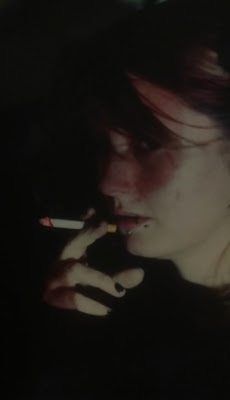
Fun fact, a cigarette doesn't glow like that unless you're actively dragging on it. Just sayin'.
This is not, though, to say that it's badly made. The design is a little wonky to my eye, but it is most definitely designed. The book is well-made, the paper is this super thick plastic-y shit that feels sort of luxurious, etc. The narrative, the visual structure, is also very effective and let's think about that some.
If I were to simply describe the photos to you in order, detailing the contents of each frame but avoiding mention of the photographic methods, you might well think it was a book about female exhibitionists. The dominant theme is women, usually modestly attractive, with their breasts exposed, mostly in locations that seem to be inappropriate (alleys, usually, but sometimes kitchens and so on.) The point is always, her breasts are showing, for no particular reason.
The second most notable theme is probably Americana/religious symbols. Is a neon cross Americana, or a religious symbol? There's not a lot of eagles, flags, crosses, but there's enough to catch the eye, and it's incongruous enough to stand out. You might decide it's about Bible Belt exhibitionists, and feel a little frisson of scolding-the-hypocrites.
Despite this, it's clearly not a book about female exhibitionists. It presents itself, and it succeeds as, a book fundamentally about the down-and-out, the drug users, the hookers, the dregs of society. Given that it's literally just a book of very ordinary looking women with their tits out, this feels rather strange.
D'Allant uses a mass of gimmickry to accomplish this. His lighting makes heavy use of car headlights (or simulations,) most of his photos are tilted, or out of focus, or motion blurred, or all of the above. Guns and dogs appear repeatedly, although they do not dominate as a theme, and it's always the same dogs and the same gun (singular) with the same perfectly ordinary looking naked girl somewhere in the frame. (This struck me as particularly lame and is emblematic of the project — you could only find one gun in Tulsa, OK? You couldn't find a single person to smoke a crack pipe or shoot up, in Tulsa, OK? D'Allant was definitely not trying very hard here.)
D'Allant is at some pains to create the impression of multiple guns, dogs, girls, but it's always the same little family. There is, I think, one other dog, but it's so blurry I confess I suspect that it's probably the same god damned dog and the same god damned naked girl.
There are a lot of shots out of car windows, to give some sort of feeling of dynamism, I guess.
The whole thing works. It feels very grindhouse. While there is literally more sex than drug use, one is left with the impression of a bunch of junkies. It turns out that if you take grainy black and white photos of a naked girl posing in an alley, lit by headlights, and talk about drugs and desperation on the facing page, you'll create a pretty brisk impression that the girl is a junkie. I feel like this says something.
I can't put my finger on it exactly, but it feels specifically cinematic. These feel like characters and scenes from movies, and by making these citations D'Allant is able to create a convincing impression while showing us virtually nothing. This doesn't make me any happier about the book, if anything it makes me angrier. He is telling, rather than showing, he's using tics and citations and gimmickry, to say nothing of text messages that I strongly suspect he wrote himself, to create a story which is simply not present in the pictures. This is the opposite of photography.
It's just girls with their tits out, lost in a sea of bullshit.
One more item, as a kind of addendum, a detail from one of the photos:
Fun fact, a cigarette doesn't glow like that unless you're actively dragging on it. Just sayin'.
Wednesday, January 19, 2022
On Portraits III
This won't really be about portraits, but it kind of flows out of the same thread of thought, so here we
are.
I have proposed in the past, and tried vigorously to sell it both to my readers and myself, that people perceive the camera's power as a thing that makes photographs; that they perceive the power of those photographs as talismans with the power to conjure. The photo conjures a kind of pseudo-presence, and the knowledge that it does so is, per this theory, what makes the camera's lens repellent. This has never sat that well with me, but it was the best I had, so I tried to like the theory. I don't think it's completely wrong, even now.
Still, there is I think something more primal in play as well, and I think that this primal thing is maybe more important.
Consider the ways we can be looked at.
In face-to-face conversation, we look at one another. We read expression and body language, in concert with the mouth noises we're hearing. Communication in this mode fully integrates sight and sound, what I see on your face modulates the meaning of what I hear you say, and vice versa. I am looking at you, you are looking at me, and neither one of us is self-conscious about this or even really aware of it. However, if you stop noticing my body language, my expression, and respond only to my words, the odds are good that the conversation is about to go off the rails.
Two people are across the room from one another, perhaps at a party. One looks at the other. The other catches the glance, arches an eyebrow. The first can smile and nod in reply, and close the loop. A conversation of sorts is occurring. The first can also let his glance slide off, pretend not to notice, or can continue to stare without making acknowledgement. This is offensive; this is rude.
We have, most of us, experienced the difference between conversational looking, and that "looking" from a loved one that makes us ask "what? do I have something in my teeth?" and perhaps even felt the switch from one mode to another mid-conversation.
The distinction is maybe one of the second person, versus the third person. I can feel when my wife withdraws and begins to see me as "him" rather than "you." It turns out that "he" has some unsightly nose hair, or something, which distracts her from the second-person looking.
At the same time, though, an audience sees the athlete or the actor in the third person, and the result is not rudeness or even necessarily cold, or particularly distant. The so-called "audience effect" has been studied, apparently, and can result in a bunch of different outcomes. To be seen, to be watched, in the third person invariably has an emotional impact. It may spur an athlete to greater performance, it may rouse the pretty girl to anger. It is, I think, always felt in some way.
I'm going to name these things social and asocial looking, on the grounds that the first kind is essentially a shared social activity, and the latter... is not.
I have no idea if there is research on this specifically. I do know that "audience effect" is a thing which has been studied, and I know that there's a lot of research around animals looking at other animals, and how it's sometimes seen as hostility or whatever. But this social/asocial distinction is not something I have specifically run across, as far as I recall. Nevertheless, I think it's very much a real thing?
I also have no idea if this is some sort of spectrum, or whether these are two distinct and separate things.
What is clear, at least to me, is that we perceive the camera as a kind of asocial looking. The camera observes, but does not take part in the conversation. The camera sees us in the third person. This has, well, it has effects. Various and sundry effects that depend on a lot of variables.
My conceit here is that there is not much functional difference between photographing someone, and staring dead-eyed at them.
The candid photograph is thus related to the kind of normal third-person people watching that is, at least in the west, perfectly acceptable. I can stare at the pretty girl, the cute baby, the interesting old gentleman, subject to certain rules: I have to be moderately discreet and fairly brief; if my gaze is observed, I have to acknowledge with a pleasant gesture (switch to social looking,) and then move on. The formal portrait strives to simulate second-person looking, the "social gaze" if you will, and often falls short.
The camera "looks" asocially, inevitably. Essentially, it has no eyebrows to waggle, and that is the end of it. The viewer of a photograph also looks asocially at the subject, because the subject cannot reply, being just a photo. In a real social interaction, subject and viewer would (might) interact, might see one another in the social mode. The photograph splits this, the camera sees asocially, and later the viewer sees likewise asocially.
I think, perhaps, this might be the root of the perceived hostility, the perceived invasion-of-privacy, the discomfort we feel, in front of the camera. It is less the photograph and its talismanic power, and more the simple stare of a dead-eyed stranger. Or, for that matter, a dead-eyed loved one.
At the same time, the dead eyed audience of the camera can spur performance, hence the smirking camera face. A model learns to act for the camera, to deliver a more useful performance than a smirk. The same lens can be seen as aggressive or hostile, leading to the raised hand and turned face or more dramatically the angry reaction (cf. Bruce Gilden, who whatever his mode, always provokes a performance of some sort.)
This does not mean that the camera is literally aggressive, it is not. It is asocial, and depending on other cues, depending on ourselves, depending on context, we react to its asocial gaze in a variety of ways.
The classical "good portrait" seems to be to be accomplished by shifting the camera's gaze as close to social looking as possible. Perhaps the subject is able, somehow, to imagine a viewer on the other side, and to "speak" with their expression and body into a void, as it were, but in the social mode. Somehow the subject is induced to respond to the expressionless eye of the camera as-if it were a social creature, as-if it were involved in the conversation, as-if it were in the second person.
The camera, somehow, becomes "you" rather than "it" if only for a moment.
Tuesday, January 18, 2022
Oh My Aching Head
Welcome to another episode of OMG, are the self-styled serious people in photography this bad?
Dr. John Edwin Mason recently posted this picture to twitter, a Victorian era photo titled "Venice - Island of San Giorgio, San Lazzaro degli Armeni, the Lido" and asked if it was taken from a hot air balloon,

which, well, remarkably lazy but whatever.
In the replies Melissa Lyttle, some random photographer with a twitter blue check, said they'd looked on Google Earth for tall structures nearby and found nothing. Another person, thank god, supplied the right answer, but by then everyone had moved on and they're all pretty sure this thing was shot from a hot air ballon.
Narrator: it was not.
Let's take a look at it. First of all, one might well be forgiven for thinking that it just feels wrong for a Victorian era balloon/aerial photo, and for good reasons. The angle of view is simply too low, this is the sort of view one can get from a tall building, so in general the aerial views from this era are taken from much higher, and offer a much steeper view.
Secondly, let's take a look at Google Maps, satellite view, to see if we can identify any of these structures. Wow, it's all still there. Venice's 500 year development plan is, I believe, to do no development:


This immediately establishes a sight line:

What's over there? Let's zoom out on google maps a little:

why look, it's the Piazza San Marco, where these is a giant campanile, indeed, the tallest structure in Venice. Perhaps Melissa Lyttle should spend a little more time learning how to use google's tools.
There's some other stuff you can look at, you can see where the horizon line hits the campanile in the picture, and deduce that you're about that high off the ground (certainly under 100m up, the San Giorgio campanile is about 64 meters total). You can measure widths of various objects and establish a range, and so on. This is all fairly simple, but perhaps beyond the capacity of a simple historian.
Anyways, it turns out that this was shot from the campanile in the Piazza San Marco, and this exact shot exists in endless variation. That particular vantage point is not a large physical space, so everyone gets exactly the same proportions and arrangement of objects in the frame, because that's the only choice you have.
We have fundamentally two problems here: First, Dr. Mason posts stuff like this pretty often, without deigning to do the slightest research, and frequently offers wrong-headed speculation. Second, his idiot followers who either also cannot be bothered to do research, or who do very bad research, reply with their own wrong-headed nonsense. Collectively they arrive at wrong answers, and move on with their lives. The collective stupidity and ignorance of humanity increases incrementally.
I find this very depressing.
Dr. John Edwin Mason recently posted this picture to twitter, a Victorian era photo titled "Venice - Island of San Giorgio, San Lazzaro degli Armeni, the Lido" and asked if it was taken from a hot air balloon,
which, well, remarkably lazy but whatever.
In the replies Melissa Lyttle, some random photographer with a twitter blue check, said they'd looked on Google Earth for tall structures nearby and found nothing. Another person, thank god, supplied the right answer, but by then everyone had moved on and they're all pretty sure this thing was shot from a hot air ballon.
Narrator: it was not.
Let's take a look at it. First of all, one might well be forgiven for thinking that it just feels wrong for a Victorian era balloon/aerial photo, and for good reasons. The angle of view is simply too low, this is the sort of view one can get from a tall building, so in general the aerial views from this era are taken from much higher, and offer a much steeper view.
Secondly, let's take a look at Google Maps, satellite view, to see if we can identify any of these structures. Wow, it's all still there. Venice's 500 year development plan is, I believe, to do no development:
This immediately establishes a sight line:
What's over there? Let's zoom out on google maps a little:
why look, it's the Piazza San Marco, where these is a giant campanile, indeed, the tallest structure in Venice. Perhaps Melissa Lyttle should spend a little more time learning how to use google's tools.
There's some other stuff you can look at, you can see where the horizon line hits the campanile in the picture, and deduce that you're about that high off the ground (certainly under 100m up, the San Giorgio campanile is about 64 meters total). You can measure widths of various objects and establish a range, and so on. This is all fairly simple, but perhaps beyond the capacity of a simple historian.
Anyways, it turns out that this was shot from the campanile in the Piazza San Marco, and this exact shot exists in endless variation. That particular vantage point is not a large physical space, so everyone gets exactly the same proportions and arrangement of objects in the frame, because that's the only choice you have.
We have fundamentally two problems here: First, Dr. Mason posts stuff like this pretty often, without deigning to do the slightest research, and frequently offers wrong-headed speculation. Second, his idiot followers who either also cannot be bothered to do research, or who do very bad research, reply with their own wrong-headed nonsense. Collectively they arrive at wrong answers, and move on with their lives. The collective stupidity and ignorance of humanity increases incrementally.
I find this very depressing.
Friday, January 14, 2022
On Portraits II
You might consider skimming/reviewing the post to which this is kind of a follow-up: On Portraits but of course I
am also following up on the remarks which immediately precede these.
When you're photographing a person, there's a lot of stuff that goes on with that person.
The early photos or Diane Arbus are all about the moment when they subject sees the camera, but before they are able to assemble a response. You see their in-repose face as it closes down, subject to further analysis.
Most portraits we see take place a little after this, with a willing subject. The subject elects to submit to the camera, and arranges their features into what they think is the right thing for a picture to be taken. They think they look good, they think this expression will please, or at least satisfy, the photographer, and so on. Retail portraits of all stripes are essentially this:
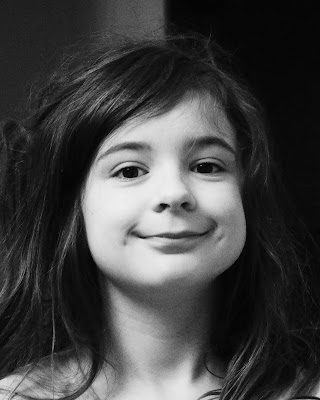
It is usually a kind of amiable smirk, and represents a kind of honesty in that this is the mask the victim wants to present to the camera. But it is a mask. The smile is the same whether the person is happy or sad inside. These are easy to take, you literally get your lights set up, get the camera in-focus, and say "cheese!" I call this look "camera face."
If you don't want the smirk, then the next thing you can do is to discourage the smirk. You can tell the subject to be serious, or otherwise let them know that the smirk is unwanted. I think some cultures, at some times, have in fact defaulted to this next thing. This was their camera face.
It is a neutral, perhaps slightly hostile, look. The driving force appears to me to be a complete loss as to what should be expressed. The subject does not want to display emotion at all, but the desire to remain hidden remains. Whether because of cultural forces, or by explicit direction, the victim settles into an opaque deadpan neutrality. This pose is just as much as mask as "camera face" but without the false, pleasing, decoration pasted on.
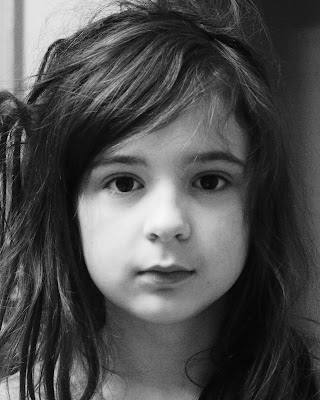
This is also a very easy photo to take. Get your lights and focus squared away, and tell your subject to wipe that ridiculous smirk off her face, and this is what you get. If you're blessed with a cultural milieu that does not smirk in the first place, you can skip the last step.
Again, it is a mask. The inner life of the subject is completely hidden, on purpose. The subject is not interested in being emotionally available to the camera. This closed-ness always seems to border on hostility, because in our normal social circumstances this expression would likely be hostility. In normal conversation, in normal social interactions, we expect, we nearly demand, a certain degree of emotional openness. It is essential to our communication that we emote at each other, that we body-language at each other. This expression is the physical equivalent of the silent treatment.
In photography it's pretty normal and not necessarily hostile. It is a kind of body-silence, but usually is driven by a lack of anything to express. It might be, as it were, a momentary silence that the camera preserves forever and which therefore stretches out eternally like a lover who turns away and will not speak.
Neither of these postures have any emotional life to them. This is not necessarily a bad thing, perhaps you're not interested in the inner life of your subject. You're interested in their clothes, or their bodies, or their surrounding. Perhaps, like Arbus, you're actually interested in the mask itself. There's a lot of stuff to do here.
However, if you want emotional life in your pictures, you have to either do a candid:
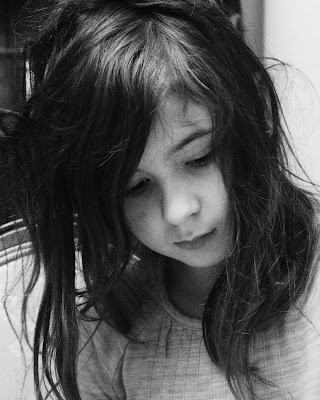
In which the emotional/inner life of the subject is visible, but not consciously projected toward the camera, or you have to do what is often called a good portrait.
The latter is very hard. The photographer has to work through the subject's instinct to close up, to hide, to mask. The subject has to be coaxed back into revealing themselves, to expressing their emotional life on their face, while simultaneously aware of the camera. Then the emotion is both present, and projected toward the camera, and thence to us, the viewers.
Kirk Tuck has a whole bunch of these things. I don't have any. All my "good portraits" are actually candids.
The trouble with modern writing about photography is that the writers lack the imagination, and the conceptual framework, for talking about anything except "good portraits" in the Kirk Tuck sense. A few may also imagine the "candid" which they probably conflate with "street."
The result is that when some part-time critic is told to wrote up someone like Diane Arbus, or Judith Joy Ross, or August Sander, they are given to understand a) that these are Good Pictures and that b) they are portraits. They conclude that the only possible reason these pictures could be good is because it reveals the emotional inner life of the subject, therefore Arbus, Sander, and Ross (as well as innumerable others) must be doing that. So they write that down, spellcheck it, and send in their copy.
An even superficial glance at the pictures would reveal that they're not doing that thing. They might well be doing something wonderful, but they're not revealing emotional inner lives, and they're not because the subjects are furiously hiding those emotional inner lives behind a deadpan mask.
When you're photographing a person, there's a lot of stuff that goes on with that person.
The early photos or Diane Arbus are all about the moment when they subject sees the camera, but before they are able to assemble a response. You see their in-repose face as it closes down, subject to further analysis.
Most portraits we see take place a little after this, with a willing subject. The subject elects to submit to the camera, and arranges their features into what they think is the right thing for a picture to be taken. They think they look good, they think this expression will please, or at least satisfy, the photographer, and so on. Retail portraits of all stripes are essentially this:
It is usually a kind of amiable smirk, and represents a kind of honesty in that this is the mask the victim wants to present to the camera. But it is a mask. The smile is the same whether the person is happy or sad inside. These are easy to take, you literally get your lights set up, get the camera in-focus, and say "cheese!" I call this look "camera face."
If you don't want the smirk, then the next thing you can do is to discourage the smirk. You can tell the subject to be serious, or otherwise let them know that the smirk is unwanted. I think some cultures, at some times, have in fact defaulted to this next thing. This was their camera face.
It is a neutral, perhaps slightly hostile, look. The driving force appears to me to be a complete loss as to what should be expressed. The subject does not want to display emotion at all, but the desire to remain hidden remains. Whether because of cultural forces, or by explicit direction, the victim settles into an opaque deadpan neutrality. This pose is just as much as mask as "camera face" but without the false, pleasing, decoration pasted on.
This is also a very easy photo to take. Get your lights and focus squared away, and tell your subject to wipe that ridiculous smirk off her face, and this is what you get. If you're blessed with a cultural milieu that does not smirk in the first place, you can skip the last step.
Again, it is a mask. The inner life of the subject is completely hidden, on purpose. The subject is not interested in being emotionally available to the camera. This closed-ness always seems to border on hostility, because in our normal social circumstances this expression would likely be hostility. In normal conversation, in normal social interactions, we expect, we nearly demand, a certain degree of emotional openness. It is essential to our communication that we emote at each other, that we body-language at each other. This expression is the physical equivalent of the silent treatment.
In photography it's pretty normal and not necessarily hostile. It is a kind of body-silence, but usually is driven by a lack of anything to express. It might be, as it were, a momentary silence that the camera preserves forever and which therefore stretches out eternally like a lover who turns away and will not speak.
Neither of these postures have any emotional life to them. This is not necessarily a bad thing, perhaps you're not interested in the inner life of your subject. You're interested in their clothes, or their bodies, or their surrounding. Perhaps, like Arbus, you're actually interested in the mask itself. There's a lot of stuff to do here.
However, if you want emotional life in your pictures, you have to either do a candid:
In which the emotional/inner life of the subject is visible, but not consciously projected toward the camera, or you have to do what is often called a good portrait.
The latter is very hard. The photographer has to work through the subject's instinct to close up, to hide, to mask. The subject has to be coaxed back into revealing themselves, to expressing their emotional life on their face, while simultaneously aware of the camera. Then the emotion is both present, and projected toward the camera, and thence to us, the viewers.
Kirk Tuck has a whole bunch of these things. I don't have any. All my "good portraits" are actually candids.
The trouble with modern writing about photography is that the writers lack the imagination, and the conceptual framework, for talking about anything except "good portraits" in the Kirk Tuck sense. A few may also imagine the "candid" which they probably conflate with "street."
The result is that when some part-time critic is told to wrote up someone like Diane Arbus, or Judith Joy Ross, or August Sander, they are given to understand a) that these are Good Pictures and that b) they are portraits. They conclude that the only possible reason these pictures could be good is because it reveals the emotional inner life of the subject, therefore Arbus, Sander, and Ross (as well as innumerable others) must be doing that. So they write that down, spellcheck it, and send in their copy.
An even superficial glance at the pictures would reveal that they're not doing that thing. They might well be doing something wonderful, but they're not revealing emotional inner lives, and they're not because the subjects are furiously hiding those emotional inner lives behind a deadpan mask.
Wednesday, January 12, 2022
Nobody Looks
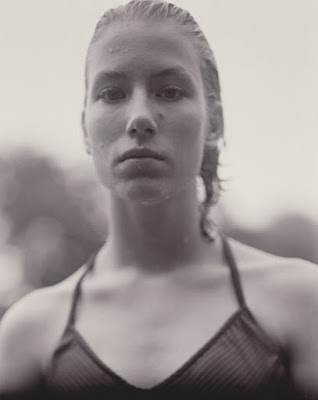
Here's a thing that is apparently making the rounds. Let me show you a couple pictures to start.
Look at them, take your time. Form an opinion. What are these people thinking, what are they feeling? Whatever.


...
...
...
The text accompanying tells us the usual story of the sensitive large format photographer and how her process does whatever it does to be especially revelatory about whatever and so on and so forth. This one, I guess, something something vulnerability without ever exploiting.
The person writing this trash has not, in my opinion, looked at the pictures. At all. They glanced and saw the chic washes of grey, the serious expressions, and then the read the press release, and that was pretty much it.
Here's the article itself. It has more pictures and, uh, some text.
These people are closed. These are utterly uninteresting portraits, like so many portraits we see from allegedly Serious Photographers working with Serious Processes. They tell us that the people open like flowers under the wondrous light of the photographer's process, and then everyone tweets stupidly about how the subjects open like flowers under the wondrous light, and on and on. But if you actually look at the pictures you see sullen, fed-up, people. Or people who are bored. Or people who are gamely trying to look not bored. Or whatever.
Nobody is opening like a flower, nobody's vulnerability is expressed let alone un-exploited.
This sort is criticism is ridiculous and stupid. This is just some blockheaded text ground out by someone who either doesn't give a shit at all, or who dopily "just loooooves" photography!!1!11111!! but cannot actually bear to spend even a couple of seconds actually looking at a picture.
The New Yorker is trash, but all the outlets do this. It's maddening. And nobody even drags them for this lazy bullshit, everyone just merrily retweets, because they can't be bothered to look at the pictures either. Look! Large format! Vulnerability! Serious Expressions! It's The New Yorker! retweet maybe with a little "gosh this is so great" comment to give the impression of giving a shit.
Honestly, fuck all these guys. Jesus.
Look at them, take your time. Form an opinion. What are these people thinking, what are they feeling? Whatever.
...
...
...
The text accompanying tells us the usual story of the sensitive large format photographer and how her process does whatever it does to be especially revelatory about whatever and so on and so forth. This one, I guess, something something vulnerability without ever exploiting.
The person writing this trash has not, in my opinion, looked at the pictures. At all. They glanced and saw the chic washes of grey, the serious expressions, and then the read the press release, and that was pretty much it.
Here's the article itself. It has more pictures and, uh, some text.
These people are closed. These are utterly uninteresting portraits, like so many portraits we see from allegedly Serious Photographers working with Serious Processes. They tell us that the people open like flowers under the wondrous light of the photographer's process, and then everyone tweets stupidly about how the subjects open like flowers under the wondrous light, and on and on. But if you actually look at the pictures you see sullen, fed-up, people. Or people who are bored. Or people who are gamely trying to look not bored. Or whatever.
Nobody is opening like a flower, nobody's vulnerability is expressed let alone un-exploited.
This sort is criticism is ridiculous and stupid. This is just some blockheaded text ground out by someone who either doesn't give a shit at all, or who dopily "just loooooves" photography!!1!11111!! but cannot actually bear to spend even a couple of seconds actually looking at a picture.
The New Yorker is trash, but all the outlets do this. It's maddening. And nobody even drags them for this lazy bullshit, everyone just merrily retweets, because they can't be bothered to look at the pictures either. Look! Large format! Vulnerability! Serious Expressions! It's The New Yorker! retweet maybe with a little "gosh this is so great" comment to give the impression of giving a shit.
Honestly, fuck all these guys. Jesus.
Tuesday, January 11, 2022
The Aggression of Photography
Theoreticians in photography are very very very fond of the idea of photography as an act
of aggression, as a harmful act. This is never justified, even slightly, it is accepted
as fact, and if you don't know the underpinnings, well, you're just ignorant. They don't
know the underpinnings either, though, but they hide this with a well-practiced sneer.
The earliest reference I know, and it is oft-cited, is Sontag. Of course it's Sontag.
Her take on this, though, is not what they think it is. She is describing the photographer's position, a position of aggression, of taking, and acquisition. Sontag lacked the language to properly work through this, mainly because she was more interested in being Susan Sontag than in establishing a firm basis for photography criticism.
As with much else in photography, the photographic process takes an ordinary human interaction with multiple (usually two) parties, and slices it neatly in two. A portrait makes the sitter "present" for the viewer, without the corresponding reverse "presence." When I look at your portrait, I experience my half of a social interaction, but you experience nothing.
In the same way, what Sontag clearly meant was that that photographer acts as an aggressor, as a looter, and a taker, without the "victim" being correspondingly aggressed against, looted, or losing anything. I "take" your photo, but you are left unaltered. I am acquisitive about photographing these African Artifacts, but I do not acquire the artifacts themselves, the artifacts remain untouched.
Standard academic photo theory completely misses out on this slicing, instead leaning toward an essentially mystical idea that in some sense the artifacts are literally looted, that in some sense the woman is raped, and so on, on and on. This is essentially rebranded "the camera steals the soul" magical thinking.
To put it more bluntly, if a pedo photographed one of my daughters, and then pleasured himself to a print of this photo, that would be gross but it would in no way harm my daughters. Yes, he would have committed a vile rape, but only his half of it. Actual harm to my daughter in this scenario would require at least two things:
First, that she be aware of this act, and second that she be educated in modern photo theory, and to understand herself to have been in some sense raped.
(if you think this is some sort of defense of CSAM you are a) wrong and b) dumb, please stop reading my blog)
Now, there is a sort of social/psychological basis here. My daughter does understand, at least roughly, instinctively, how photographs generate a kind of presence. She would undoubtedly feel grossed out, and she might lean toward the modern theory purely on the basis of her instinctive understanding of how photos work.
This in no way changes the atavistic attitude that underpins this notion. My daughter, in that icky eventuality, would be leaning on a primitive soul-stealing attitude about photography, rather than understanding in a subtle and nuanced way that the photograph slices the interaction in two. The pervert rapes, but she is un-raped. Ok, so she's 8 or 12 depending on which one, and this might be a stretch. Nevertheless Sally Mann's children famously understood the difference between a photograph and themselves.
This is not a wildly difficult distinction to draw. It is the correct distinction to draw. It does require a little sophistication, the natural, atavistic, response is the one that is wrong. It is built on cognitive machinery that is out of date, that does not grasp the idea of a human interaction that is split in two by a sufficiently realistic picture.
Nevertheless, the photograph does split the interaction. I do not feel your gaze when you look upon my portrait. I just do not.
The fact that I know you could, and that at some lizard brain level I am disturbed by that, does not alter the reality of this slicing.
This is not to entirely reject the feelings of the lizard brain. The lizard brain feels violated, and to some extent that is potentially a "harm" but it is at best a diffuse harm, a slight harm. How much weight should be accord it?
Some weight, surely. But not infinite weight. The misplaced feelings of the lizard brain should be respected, but they should not be allowed to drive. Lizards are notoriously bad drivers.
Subscribe to:
Posts (Atom)