In someplace I frequent (slum) someone I don't respect recently asked about nudes, essentially asking
why most of them are so tawdry. He got a lot of answers like "Weston was a master" and "read Paglia" and the inevitable "female gaze wot wot" but nothing actually on-point because photographers, for the
most part, don't have any ideas.
It did occur to me that this is a topic I have not revisited in a while, as my thinking about photos
has evolved and changed, so now seems like a reasonable time to approach it again.
Unless otherwise stated, the gender of the subject doesn't matter in this discussion.
Confronted with a photo of an unclothed person, we enter the scene in the photo in some way. We are
in a sense present and in the presence of an unclothed person. One naturally wonders why this person is unclothed.
The obvious answer, and this usually is painfully obvious, is that it is because the model has removed
their clothing at the behest of a photographer, for the purpose of being photographed. In these cases,
we must set
aside this story, suspending our disbelief as we would for a movie or a novel, and proceed into the
fictional story we're being asked to partake of.
At this point we can begin to enumerate possibilities. I think it is fair to suppose that it's enough
to simply articulate possibilities, the details of converting a description into a photo are essentially
technical (acting, direction, lighting, etc.) and to be honest I don't much care.
The first and most obvious story is that the subject of the photograph is sexually available. Possibly
to me, the viewer, but also possibly not to me. Perhaps the point is that the model is sexually available
but explicitly not to me. This is the fiction embedded in almost every nude photograph, this is the point.
This is what we think of as tawdry or shallow, even though there's no particular reason to suppose any
such thing. Sex is a pretty big deal.
It is here that the gender differences arise in a big way. Sex is asymmetrical, both physically and
politically (yes, yes, with certain exceptions) and so the nude woman, presented as sexually available,
is different from an equally available man. So be it.
Photographers who want to be seen as serious, or who are genuinely just not much interested in the sexually
available subject, can deploy a bunch of strategies to negate the story of sexual availability.
You can stand the model atop a rocky pinnacle, place them pensively in a snowy landscape, depict them in
the throes of athletic strain, or simply put them in a box. All these things can be mechanics which
disrupt or negate the notion that the model is sexually available. Frequently they're just weird. The
main trope here is to negate the sexual availability by replacing it with a mystery. Why is she sitting
down in the snow? Why is he rock-climbing naked?
Another option is the candid, or the faux candid. The model is shown to us in a natural state of
non-sexualized nudity, and we as viewers are placed in the position of a voyeur. Nothing in the picture
explicitly welcomes us into the scene, we're not supposed to be there. Therefore the model is
not presenting themselves as sexually available — they are "not aware" of us. This tends to be
a little creepy, but can be charming if we can manage to set aside our role as voyeur.
But the truly warm and non-sexual nude photo is a rarity.
Those of you who have been in relationships may have noticed that nudity is not strongly correlated with
sexual availability. I venture to suggest that many close relationships, whether between sexual partners,
or between a parent and a child, or even some close friendships, involve quite a bit of non-sexual nudity.
The genuinely intimate nude strives, I think, for that.
These nudes are not candid, but nor are they built around sexual availability.
In these photos, the model is engaged; the model "sees" you, as in any non-candid portrait. Sometimes
the method is to place the model in a situation where they are more or less naturally unclothed, but
engaged in something that makes sexual availability ludicrous. This does tend to blend over into the
"stick the model somewhere weird" but there are ways to make it less weird. It is, I think, also possible
to accomplish this without artifice, but the model has to be able to project pretty specifically.
Another trope to deploy here is to use unattractive models. Old men are rarely seen as sexually
available, no matter how naked. Nudes of children, when not kiddie porn, are also a kind of
"not sexually available" freebie.
Regardless of how accomplished, the model in these pictures
is not specifically available for sex but is nevertheless unclothed. This implies an intimacy, a warmth,
a closeness. We are present with a person who is open to us, who does not hide their body. Since they
are not unclothed for the purpose of sex, they are not merely making their genitals conveniently
accessible for use, and so perhaps we imagine that they hide nothing at all from us.
I think at this point, having articulated the situation, the mechanics perhaps come more easily.
We know the difference between the body language of sexual availability, and the other body languages.
This is a problem of acting and direction. We know the tropes of porn, of candid photography, of the intimate portrait. Deploy them accordingly, in the proportions you're looking for.
Another great victory for the Molitor Presence Theory of photography.
Saturday, February 19, 2022


Thursday, February 17, 2022
Photography is Not a Language
One of the more common dopey aphorisms trotted out by "serious" photographers is that photography
is a language. This is wrong, at so many levels.
First, in any sort of technical way, photography is not a language. While the definition of "language" is somewhat contested, absolutely nobody thinks that a pile of signs, in the semiotics sense, is a language. It just isn't. Vocabulary is not language, as anyone who has tried to learn a language from a dictionary knows. At best photography has a kind of vocabulary.
This is in fact what people mean: they mean you can print it dark, you can stick a crucifix in the frame, you can tell your model to grimace. These are all signifiers which point to something other than themselves, they are signs in the semiotic sense. I am at a loss for a better word than "language" to describe this, and so, apparently, is everyone else. You could argue that, imprecise as it is, "language" is the best word to describe this. More on this in a moment.
There is another possible meaning here, which is that a picture of a tree is not the tree. It signifies the tree, and is therefore a sign for the tree. This feels potentially interesting in a very technical way, but even Barthes couldn't actually make any hay here, so it's more likely a dead end. This is a technical curiosity, and in the end sort of dumb and uninteresting. We acknowledge that the tree (or frog, or model, or cloud) is not the photo of itself, but other than to note the obvious distinction there doesn't seem to be much there.
Ok, back to "language" as sloppy but maybe appropriate.
The trouble with accepting this as-is, is that it emphasizes the wrong thing. Yes, there are signs that can be added to, or managed, in a photograph, but this is a relatively bush-league operation. The main thing a photograph does is copy reality, preserve it in a limited kind of way, and allow us access to that pickled reality. The main thing you as a photographer do is select which bits of reality to do that to.
The idea of promoting photography as a "language" is part of a larger program to enlarge the photographer's role in the making of the photograph. It goes with the mealy-mouthed "photos are made, not taken," and it rubs up against ideas like "gaze." This set of ideas is very attractive to photographers, who generally want to see themselves as kind of like painters, imagining that Leonardo got laid a lot. It's also attractive to theoreticians who constantly seek grounds to expand the scope of their favorite activity, which is scolding people.
The conceit is that the photographer is visible in the frame, is speaking through the language of photography.
A photographer takes a picture of a cat, and I don't like the photographer. I can see in the photo the essential badness of the photographer. You can just tell, by signs, because photography is a language, that the photographer is a bad person who hates cats.
The idea that photography is a language is part of a larger system of thought which argues that we can and should see things in the photos which we know to be true outside the photos. It allows theoreticians to project things into the photograph which simply are not there. The idea that photography is a language is thus quite harmful to actual understanding of how photographs function.
Most of what we "read" in a photograph comes not from the photograph, not from some notional "language" or system of signs, but from ourselves, from the things we know, from the things we see around the photo, processed through ourselves and projected onto the picture.
Tuesday, February 15, 2022
The Roots of Meaning
A few days ago one of the people I consider to be a basically superficial klout-farmer (but by no means
the only one, god help us all) on social media made this remark:
Now, forgive me, but I think if you're going to characterize some remark as "X in a nutshell" there should be at least some small thing that's specific to X in the remark. Asking questions and listening to the answers is a great idea, but it applies equally well to architecture, taco making, and photography.
I found this to be essentially glib nonsense, and said so.
To my astonishment, a chap who I consider to be quite thoughtful and intelligent charged up guns blazing and informed me otherwise! He unpacked it into a surprisingly lengthy treatise on diversity in photography, with a special emphasis on photojournalism!
Which, ok, fair enough. This is one of those glib epigrams upon which you can project anything at all, and it is indeed designed for that purpose. This is a dopey remark designed to let you project your own ideas onto it, and then subtly attribute those ideas to the fellow who made the remark, and conclude "what an intelligent fellow, he agrees with me on so much!"
I'd kind of like to throw some shade on the other fellow, the one who unpacked the remark into a treatise on diversity, but I really can't, and my heart isn't really in it anyways.
The point is that so much of the meaning we make of things comes from within ourselves. It's bonkers.
Given a profoundly open snippet of language, we can project pretty much anything we want onto it. We could interpret is as reminding us that we need to ask a lot of entomological questions, and listen to the answers, if we want to photograph bugs. We could interpret is at reminding us to be engaged and interested, when we're taking portraits. All of these interpretations, and infinitely many more, might well make this glib snippet feel smart and on-point.
But we're the ones bringing all the meaning. The words are just a trigger, a key that unlocks, and all the meaning was inside us already.
And so thus with a photograph, no? Especially a photo with no context. If we can make such hay out of mere words, with their relatively narrow and strict definitions, imagine what we might make of a photograph.
We see the window into a little world, and we fill it in, with things from inside ourselves. Not merely what's out of frame, or what happened next, but what the people in the frame are thinking, what the meaning of the actual frame contents. It's practically all us. The photographer can maybe guide, a little, can maybe hint, a little.
It makes the whole affair a bit daunting, some days.
If you don't ask questions, you won't get answers. If you don't listen carefully you won't
understand the answers. Photography in a nutshell.
Now, forgive me, but I think if you're going to characterize some remark as "X in a nutshell" there should be at least some small thing that's specific to X in the remark. Asking questions and listening to the answers is a great idea, but it applies equally well to architecture, taco making, and photography.
I found this to be essentially glib nonsense, and said so.
To my astonishment, a chap who I consider to be quite thoughtful and intelligent charged up guns blazing and informed me otherwise! He unpacked it into a surprisingly lengthy treatise on diversity in photography, with a special emphasis on photojournalism!
Which, ok, fair enough. This is one of those glib epigrams upon which you can project anything at all, and it is indeed designed for that purpose. This is a dopey remark designed to let you project your own ideas onto it, and then subtly attribute those ideas to the fellow who made the remark, and conclude "what an intelligent fellow, he agrees with me on so much!"
I'd kind of like to throw some shade on the other fellow, the one who unpacked the remark into a treatise on diversity, but I really can't, and my heart isn't really in it anyways.
The point is that so much of the meaning we make of things comes from within ourselves. It's bonkers.
Given a profoundly open snippet of language, we can project pretty much anything we want onto it. We could interpret is as reminding us that we need to ask a lot of entomological questions, and listen to the answers, if we want to photograph bugs. We could interpret is at reminding us to be engaged and interested, when we're taking portraits. All of these interpretations, and infinitely many more, might well make this glib snippet feel smart and on-point.
But we're the ones bringing all the meaning. The words are just a trigger, a key that unlocks, and all the meaning was inside us already.
And so thus with a photograph, no? Especially a photo with no context. If we can make such hay out of mere words, with their relatively narrow and strict definitions, imagine what we might make of a photograph.
We see the window into a little world, and we fill it in, with things from inside ourselves. Not merely what's out of frame, or what happened next, but what the people in the frame are thinking, what the meaning of the actual frame contents. It's practically all us. The photographer can maybe guide, a little, can maybe hint, a little.
It makes the whole affair a bit daunting, some days.
Thursday, February 10, 2022
LENSWORK
Brooks Jensen (I think it's him?) of LENSWORK linked here a few days ago, I think, and said some very lovely things about me in an audio clip attached to his link, that I make him think even (perhaps especially) when he doesn't agree with me. I won't say I teared up, but it was a damn near thing.
Thank you Mr. Jensen. It's always very nice to hear that I have succeeded. To make people think, without the necessity of agreement, is precisely the point. Of course it would be in a way great if everyone agreed with me, but while comfortable, that would simply be proof that I'm not trying hard enough.
My name, by the way, is Andrew Molitor. It should be somewhere in the maze of informational "Pages" accessible from the sidebar, but I can't honestly say quite where or if I'm 100% sure it's even there.
The British Journal of Photography
BJP was sold a few days ago. Sold, I should remark, again. It has been sold many times.
What makes this sale notable to me is that the sale is being touted by, uh, people on twitter, as a huge fraud, a Ponzi scheme, a criminal action, and so on. Let us just say libels have most likely been made, but in all probability nobody is going to pursue action against anybody.
Let us unpack the history of this! Why? Because it's fun!
In 2013 Marc Hartog led a management buyout of BJP. At the time, BJP was (I think) one many properties held by Incisive Media which was, and perhaps still is, a publisher of magazines. This was in the midst of some sort of transition to digital, Hartog had been leading or at least involved in the internal program to bring out digital editions of BJP.
Hartog created an empty company, Apptitude Media, and sold off 25% of it to investors for some money on the basis that he was going to buy BJP from Incisive. When the deal closed, Incisive held 15% of Apptitude, Hartog 60%, and 18 other investors held the 25%. Hartog almost certainly put in a significant investment of his own, but if and how much are privileged information. It would be normal for him to have put in a large chunk, though. Incisive likely got a chunk of cash, and 15% of Apptitude, and in exchange transferred BJP to Apptitude. Some of the invested cash would also have been used to provide operating capital for the new company.
At this point Hartog owned a majority stake in a company, Apptitude, that owned all the bits and pieces that make up BJP. The new company began to search for ways to make a photography magazine work as a viable, ideally large, business.
Many things were tried, I guess. I don't really know or care about the details, the point is that they don't seem to have worked. In 2016 they decided to try fundraising. They used the Crowdcube platform which, insanely, allows ordinary citizens to invest in private companies. The pitch was quite rosy, and valued the company at several million pounds which is, well, optimistic. As these things are. Financial statements were provided, which of course the punters who put in £10 to buy 68 shares almost certainly did not understand.
The point of this fundraising is obviously to create a little financial elbow room to try some stuff out. Whether you view it as money raised to try the new stuff, or money raised to make payroll while other money is used to try stuff is a personal choice. Money is fungible.
In 2016 they raised £399,720 by selling off %13.55 of the company to all comers. Half of this investment came from Stephen Henly and Jonathan Mitchell who invested £100,000 each and were duly appointed to the board of directors.
In 2018 there is essentially a repeat. They raised £779,510 by selling off %14.2 of the company (note that shares seem a lot cheaper this time around, the outlook, while still optimistic, is less optimistic!) In this round, Jahan Mobasher and Simon Bishop invested £100,000 each and were appointed to the board.
In 2020 there is yet a third round, raising £379,280 for a mere %5.44 of the company! The outlook was much rosier this time, somehow. Jonathan Woyton invested £200,000 (twice as much as necessary to get a board seat) and Joseph Phelan invested £100,000. Again, they were duly appointed to the board.
In all this fundraising a total of £1,558,510 was raised by selling off something like 30% of the company (you can't just add the percentages together, but roughly.) Of that, £700,000 was from people who became directors of the company. At some point in there Apptitude changed its name to 1854 Media.
So has there been fraud up to this point? I cannot see it. 6 separate people made enormous investments based on the rosy, optimistic pitches, and became directors of the company with access to everything. Having been a director, I can attest that this doesn't mean that they went through the books carefully, but they were on the inside, they did have fairly detailed, fairly accurate, financials read out to them, and they had at a minimum of a rough idea of what was going on.
I assume, I think reasonably, that at least a few of these 6 would have noticed something amiss and raised a fuss if there had been real malfeasance in the fundraising efforts, or in the company itself, up to now.
It is possible that there was something crooked going on, but if so it was very well hidden, or all these directors were In On It or something. As we shall see this, while unlikely on the face of it, is even less likely than you might think.
The high estimation of the company's value in January of 2020 seems peculiar, but I think they'd opened a bunch of initiatives which were about to get crushed by, um, a thing I have promised to not talk about.
By early 2021 they were thinking hard about NFTs, which makes me sad, but what are you gonna do? From a business perspective, it's not a terrible idea. Sure, people like me were saying NFTs were going to be a short-term fad, but plenty of people were saying the opposite.
At this point, early 2021, I think management has decided they are extremely short of options. The photography magazine business was not going well for anyone, virtually all the magazines have long since shuttered and the ones that are left were pretty small operations. At best the choice was between downsizing to a tiny but viable shop, or trying one more large-scale initiative to build a more substantial business. At worst it was a choice between closure and this last go-big attempt.
At this point the public financials were at least consistent with them borrowing money and selling more shares simply to make payroll. Combinations of selling shares and borrowing money is pretty normal at this stage of the game. You're simply trying to buy breathing room to figure out what to do.
Something has been made about the fact that the most recent share sales were at the previous, fairly rosy, price. Fun fact, you kinda have to sell them at the previous price. You can't just sell shares for whatever, because selling even one share at a price implicitly values the company. If I sell you a share for 1p, and there are 27M shares, I am stating that the company is now worth £270,000. You don't make moves like that on a whim (I'm not even sure it's legal?) So anyway of course the shares were sold for whatever the most recent share price was.
It's even money that former director Stephen Henly (see below) was the buyer for many of those shares, and possibly also the lender. This would be, at least, not unexpected.
So, in early 2021 they launched ART3.io, a platform for NFTs under the BJP brand, and whatever, it does something. It was successful enough to be interesting to Marc Hartog, at least.
By the end of 2021, a decision was made to spin out the ART3.io brand. Hartog once again created an empty company to contain the ART3.io bits and pieces (domain name, intellectual property, branding, assets, whatever.) At the begining of Fed 2022, former director Stephen Henly (who invested £100,000 in 2016) purchased the company (now called 1854 Media) in some sort of deal, probably not involving a great deal of cash, and Hartog left 1854 Media to lead the new ART3.io.
Oddly enough, what has social media afire is that Hartog seems to have acquired the BJP twitter account as part of the package. This twitter account was largely worthless, having about 250,000 followers and low engagement. For reference, that is not enough following to support one (1) influencer. By like an order of magnitude.
As part of the sale, a sum of £50,000 was provided to pay out the shareholders. All 27 million-odd shares. This is privileged information, but has been publicized widely by, um, irresponsible people. It's the sort of private information you don't seriously expect to stay private, though.
The guys who bought 38 shares for £10 are not gonna be very happy with their 7p and that's understandable. Note, though, that Mitchell, Mobasher, Bishop, Woyton, and Phelen will be getting a few hundred pounds back for their much, much, much, larger investements. And let us recall that these men have lawyers.
Again, is there fraud at this point?
It certainly is being pitched by, um, individuals, as some sort of "someone ran off with all the money" situation, but there's no evidence that there was any money. The publicly available financials indicate debt, rather than cash.
No matter how I slice and dice it, there just doesn't seem to be any way any meaningful pile of money ever accumulated in this thing. In fact, I can't see how any money at all actually accumulated. It's possible that all the filings are completely fraudulent, but at this point we're assuming a conspiracy involving a whole bunch of people, and the fraud would have to be fairly monumental to even give the 6 directors their £700,000 back.
While, I suppose, theoretically possible, I am having trouble visualizing how a massive fraud fits inside a photography magazine, a business type not noted for have vast revenue streams to hide money in. You might as well propose that BJP was just a cover for a massive drug dealing operation, and that there are millions in illicit fentanyl money lying around, at which point we really seem to have lost the thread?
People are mad because they lost their money, and sure, I get it. That sucks. They clearly had no idea what they were getting into, and feel lied to. That's kinda on them, but also kinda not.
Other people are mad because Hartog acquired a twitter account on terms that are definitely not known, and are much more likely reasonable and fair than otherwise. Which, ok, those are just crazy people I guess?
Yet other people are mad because of the NFT connection. I think NFTs are dumb and bad too, but these are business decisions, and as business bets go, that one doesn't seem any dumber than the underlying "let's run a photography magazine" idea.
There's literally no room anywhere in here for any kind of actual fraud or malfeasance. To seriously propose that, you have to assume that all public information is simply falsified, which seems dicey to me.
But, in the end, nobody is seriously proposing that, they're simply performing for social media klout, or because they're upset, or because they're bullies.
Wednesday, February 9, 2022
God Damn It
If his social media is any indication, Jörg Colberg is financially against the wall. I disagree
with him about everything, but this should not be taken as an indication that he's actually
wrong as such. It certainly doesn't mean he's not doing anything of value. He tackles
interesting questions from time to time, with tools that I consider inadequate, but again that's
my opinion.
He personally dislikes me, which would make any attempt from me to support him at least embarassing. Also, I have no need for any of the several things he offers, so anything I did for him would be purely charity and my charitable giving is very structured and does not include writers that dislike me.
Nevertheless, he offers consulting services of various kinds at ludicrously low prices. He has a book and perhaps some prints you can buy. He has a Patreon.
Some of you may reasonably find genuine value in some or all of this. We're still friends if you do. If you've been thinking about it but not committing, I think now might be the time.
Colberg's Patreon: here
Consulting: here
You can contact him directly to buy shit or whatever: jmcolberg (at) gmail.com
Honestly, I am tense and irritated now. I don't want to be panhandling for this fucking guy, but I cannot in good conscience let him starve without at least making a slight effort.
Thursday, February 3, 2022
Something to Look At
Ran across this photo today. This are police officers lined up along 5th Ave for the funeral of a fellow officer, Wilbert Mora. Pretty sure the photographer is Mark Peterson (he posted it online, and didn't give an explicit attribution to anyone else, so I assume it's him:)
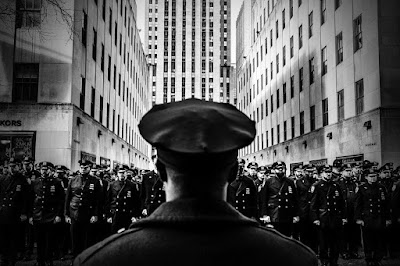
So what do we see?
An anonymous uniformed figure, foreground. Back turned to us. Shoulders square, one might suggest a vaguely military posture. Facing that figure, a loose formation of what are recognizably police officers. Perhaps because we see more of their bodies, they seem a hair less military. The mood is somber, the expressions are serious. Row upon row of uniformed men, rendered in stark black and white.
Behind them, a skyscraper vanishes off the top of the screen. To both sides, more cement buildings. Nothing is brutalist, but nothing seems aggressively art deco either. On the left, the word KORS over a shop window. On the right, more windows recede with writing above them.
There is a pretty heavy vignette, or at least the appearence of one. This focuses attention on the center, around the cap of the foreground officer (we assume it's a cop, the hat matches, etc), and lends, at least to my eye, a little flavor of "old black and while film" which is supported by the rest of the technical details of how the photo is handled (high contrast, very deep blacks, etc)
What we are in fact looking at is Rockefeller Plaza, we're looking across 5th Ave into the Plaza. The building in the background is Rockefeller Center. The KORS is of course MICHAEL KORS and we are looking at shops selling luxury brands, lining the Plaza. We are looking directly in to, if not the heart, at least one of the hearts of the American Capitalist Dream. The buildings are in fact considered to be Art Deco style. The photographer, ingeniously, eliminates any central features of the plaza by hiding them behind a big hat. There's probably a big dopey sculpture of some sort back there, which might rather ruin the mood.
Now, where have I seen row on row of uniformed figures juxtaposed with large Art Deco concrete structures. Hmm. Hmmm.
Oh! I know! A little film out of Germany made by Leni Riefenstahl! Triumph of the something.
At this point, though, the ranks/masses of identical dark figures arrayed in front of impossibly large, often art deco, concrete structures is a movie trope, and it never means that we're having a fucking birthday party.
So what do we make of these cops? Well. The mood is serious, the visuals are definitely Heroic Realism. We have a subtly lowered angle of view, we have massed power, we have the largeness of the anonymous cop foreground, we have the buildings vanishing off the top of the frame. It's all big, it's all power.
It's black and white, it's dark, it's high contrast.
You could certainly see this as a somber heroism, an ode to a fallen soldier. You'd have to be.. slightly tone deaf? Or kind of authoritarian? Maybe? I dunno, I feel like you'd have had to been rooting for the bad guys in an awful lot of movies, but maybe.
If you're me, of course, you go "holy shit, could you possibly make these guys look more like Nazis?"
Which opens up a meta-analysis, why the fuck would you go to such lengths to make cops look so bad? Or is the photographer? I don't even know!
I think this is a photo that could easily go in a bunch of directions. "Cops! Fuck Yeah!" or "ACAB and Nazis too!" or "Why you so harsh on our cops, dude?" or "how dare you make those Nazis look so heroic!" and maybe more.
This is a picture that I think could go any which way, and it pretty likely to give several different audiences exactly what they way. In a way there is a kind of mad genius to it, I guess.
Subscribe to:
Posts (Atom)